UNITED DON’T RUN. THEY DON’T WIN. SO WHAT EXACTLY IS CARRICK’S PLAN?
Manchester United rank near the bottom of the Premier League for sprints and high-speed running. But is that a deliberate tactical choice or evidence that Carrick’s system is failing to demand enough from his players?
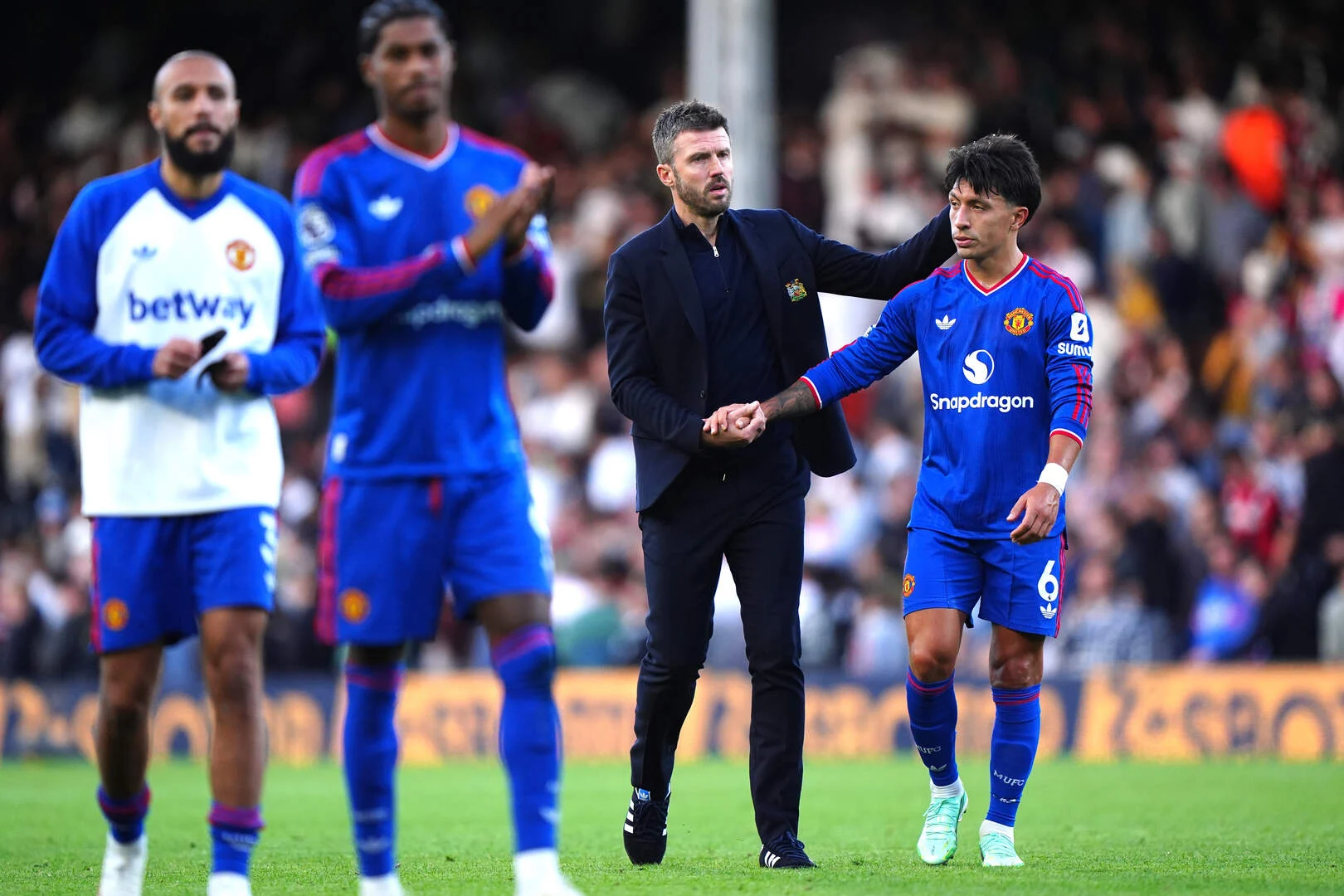
If Manchester United Aren’t Running, Is Michael Carrick Asking Them Not To Or Have They Simply Stopped Competing?
There is a number sitting quietly underneath Manchester United’s troubled start to the 2026/27 season.
It is not their league position.
It is not their points total.
It is not even the number of goals they have conceded.
It is 449.1 kilometres.
That is the distance Manchester United’s players have collectively covered across their opening four Premier League matches.
It puts them 14th in the division.
More revealing, however, are the numbers at higher intensity.
United rank 18th for total sprints, with 379, and 19th for high-speed runs, with 1,364. When those figures are adjusted for the distance the team has covered, they remain near the bottom of the league.
Then came Fulham.
United covered approximately 110.2km at Craven Cottage.
Fulham covered 116.7km.
A difference of roughly 6.5km.
And suddenly, the question being whispered around Old Trafford became impossible to ignore:
Is Manchester United’s lack of running a problem — or is this simply Michael Carrick’s football?
That is where the investigation begins.
THE EASY ANSWER IS THE WRONG ANSWER
Football has developed an unhealthy obsession with running statistics.
A team covers more ground than its opponent and people immediately conclude that it wanted the game more. But football is considerably more complicated than that.
Running statistics measure what happened physically.
They do not automatically explain why it happened.
A team dominating possession may not need to chase the ball.
A team defending in a deep block may deliberately allow the opposition to have possession in harmless areas.
A side playing a controlled mid-block can move as a unit rather than sending individuals charging after the ball.
And a team that constantly loses possession may run enormous distances simply trying to recover its shape.
In other words:
More running does not automatically mean better football.
That distinction matters enormously when examining Carrick’s Manchester United.
The question is not whether United should simply run more.
The question is:
Are they running less because Carrick has designed a system that requires less unnecessary movement or because the team is failing to produce the high-intensity actions the system actually needs?
Those are two completely different problems.
WHAT EXACTLY ARE THE NUMBERS TELLING US?
Let’s separate the statistics.
Total distance United’s 449.1km puts them 14th in the Premier League after four matches.
The more interesting information is what happens inside those kilometres.
Sprints
United have recorded 379 sprints.
That ranks them 18th.
High-speed running
They have recorded 1,364 high-speed runs.
That ranks them 19th.
This creates a fascinating distinction.
Manchester United are not necessarily incapable of covering ground.
They appear to be doing less of the explosive running associated with high-intensity football.
And that is much more interesting.
Because modern football is not won simply by running 115 kilometres instead of 110.
It can be won by making the right five-metre movement at the right time.
The problem comes when those movements are not happening quickly enough, frequently enough or collectively enough.
WHAT DOES CARRICK ACTUALLY WANT?
This is where the tactical investigation becomes important.
Carrick has not arrived at Old Trafford preaching uncontrolled chaos.
His football is built around structure.
This Season, United have been encouraged to build from the back, use short passes and create positional relationships through midfield. Their shape can change depending on possession, with the team moving into different structures as the ball progresses.
Out of possession, the principle is also not necessarily “everybody sprint towards the ball.”
Carrick’s approach has elements of a mid-block: remain compact, protect central areas, control space and choose moments to press.
That is fundamentally different from a team whose entire identity is built around relentless high pressing.
And this is why judging Carrick’s football solely through kilometers would be intellectually lazy.
If your tactical objective is to keep your distances between players short, close the centre and force opponents towards less dangerous areas, your players should not be running around like headless chickens.
The best defensive movement can sometimes be the movement that doesn’t happen.
A player holding his position can be more tactically valuable than a player sprinting 30 meters to make a tackle.
BUT HERE IS THE PROBLEM
There is a massive difference between controlled movement and insufficient intensity.
That is where Manchester United’s statistics become uncomfortable.
A mid-block still requires acceleration.
A compact defensive structure still requires players to shift.
A pressing trigger still requires somebody to explode towards the opponent.
Transitions still require speed.
Counter-attacks still require runners.
Recoveries still require players capable of covering ground quickly.
And when United lose the ball, the question becomes brutally simple:
Who is going to run?
This is where the statistics become more useful.
United’s low sprint and high-speed numbers do not prove that Carrick’s tactical philosophy is wrong.
But they do raise a legitimate question about whether his players are executing the physical demands of that philosophy.
THE FULHAM GAME MADE THE ARGUMENT LOUDER
The 1-1 draw at Fulham has given the debate another layer.
Fulham covered approximately 6.6km more than United.
United eventually rescued a point through Matheus Cunha’s late deflected equaliser, but the physical disparity became one of the dominant talking points after the match.
And here is where things become particularly interesting.
Cunha himself questioned the team’s energy during the match.
Carrick disagreed with the suggestion that United lacked energy and pointed instead to the team’s fighting spirit and the way they continued pushing towards the end.
That disagreement matters.
Because it reveals two competing interpretations of exactly the same performance.
The players’ interpretation: We didn’t have enough energy.
The manager’s interpretation: The team showed enough fight and resilience.
Both cannot fully explain the same performance.
And that is precisely why the running data deserves examination rather than dismissal.
Fitness and match running are related, but they are not identical.
A footballer can be physically capable of running 12km and still be instructed to run 10km.
Likewise, a team can cover enormous distances while being tactically disorganised.
There is another important piece of context.
Carrick has reportedly favoured shorter, sharper training sessions compared with the previous regime, placing emphasis on intensity and sharpness rather than simply accumulating running volume.
THE MOST IMPORTANT STATISTIC MAY NOT BE DISTANCE
Consider two hypothetical teams.
Team A runs 115km.
Team B runs 108km.
Team A loses 3-0.
Team B wins 3-0.
Which team worked harder?
The answer is not automatically Team A.
Distance is context-dependent.
What matters is where, when and why the running occurs.
Imagine a centre-forward sprinting 30 metres to press a goalkeeper.
If the midfield does not move with him, his sprint may achieve nothing.
Imagine a full-back making five recovery sprints.
If his team repeatedly loses possession in dangerous areas, those sprints may simply be emergency repairs for earlier mistakes.
This is why serious football analysis increasingly looks beyond raw distance.
Intensity. Timing. Direction. Position. Synchronisation.
Those are the hidden layers.
AND THAT IS WHERE UNITED’S NUMBERS SHOULD WORRY THEM
The concern is not that United rank 14th for total distance.
Because, “United don’t run.”
It may be:
“United don’t accelerate enough.”
And that is a completely different problem.
Acceleration is one of the fundamental currencies of modern Premier League football.
It determines whether you reach a loose ball first.
Whether you close down a centre-back before he can turn.
Whether you recover behind your full-back.
Whether you exploit space behind an opposition defence.
Whether you turn a turnover into a counter-attack.
Whether you stop an opposition counter before it becomes dangerous.
You can have a team that moves intelligently and still needs more explosiveness.
WHAT ABOUT THE ARGUMENT THAT WINNING TEAMS DON’T NECESSARILY RUN MORE?
This is perhaps the most important point for anyone analysing the numbers.
There is no simple rule saying the team that runs furthest wins.
Football is not an athletics race.
The relationship between running volume and winning is complicated by possession, game state, tactical approach, opposition behaviour and scoreline.
A team protecting a lead can behave completely differently from a team chasing an equaliser.
A team dominating possession can produce fewer defensive running actions.
A team being dominated may produce huge defensive numbers.
So if somebody says:
“United run less, therefore they are worse.”
That conclusion goes too far.
But if somebody says:
“United’s exceptionally low sprint and high-speed numbers deserve investigation because those actions are important components of pressing, recovery and transition football.”
That is a much stronger football argument.
THE QUESTION UNITED FANS SHOULD REALLY BE ASKING
Forget:
“Why aren’t they running 115km?”
Ask:
When United lose possession, how quickly do they react?
When the opposition breaks, how quickly do United recover?
When Carrick’s pressing triggers appear, do the players actually attack them?
When United win the ball, are there enough runners ahead of it?
Are the distances between United’s lines allowing opponents to play through them?
Are United’s forwards pressing as a unit or individually?
Are midfielders closing space or merely occupying it?
Are full-backs being asked to attack without sufficient recovery support?
Those questions tell us much more than the raw kilometer count.
AND THERE IS ANOTHER PIECE OF THE PUZZLE: THE PLAYERS
It would be convenient to make Carrick the sole suspect.
But football rarely works that way.
Managers establish principles.
Players execute them.
Recruitment determines whether the squad contains the physical and technical profiles required to execute them.
The club’s recruitment strategy also deserves scrutiny.
If the intended football requires aggressive transitions, recovery speed, pressing intensity and repeated high-speed actions, then the squad must contain enough players capable of delivering those behaviours.
You cannot build a Formula One strategy with a squad assembled for a completely different type of race.
SO, IS THIS CARRICK’S FAULT?
Not entirely.
Is it the players’ fault?
Not entirely.
Is it simply a fitness problem?
The available evidence does not prove that.
Is it purely tactical?
Again, the numbers do not prove that.
Carrick now has to demonstrate that it is deliberate, functional and sustainable.
Because if the low-intensity profile is part of the plan, United need to show what they are getting in return.
More control?
Better possession?
Fewer chances conceded?
Better transitions?
More efficient pressing?
More goals?
More points?
Something must compensate.
Manchester United do not have a problem simply because they are running less than other Premier League teams.
Football does not work like that.
But neither can the club simply dismiss the numbers as irrelevant.
Those figures don’t prove that Carrick’s football is wrong.
They don’t prove that the players are unfit.
But they do establish a legitimate question:
Is Manchester United’s lower physical output an intentional consequence of Carrick’s controlled football — or is the team failing to produce the intensity required to make that football work?
That is the question Old Trafford should be asking.
Because running is not the objective.
Winning is.
But in modern football, winning often requires knowing when not to run, when to run, and perhaps most importantly when to explode.
Manchester United’s next challenge is proving that they know the difference.
Read next
Stories you should not miss

Breaking
Silenced? Martínez's Apology Smells Like a Club in Damage Control, and INEOS Has Questions to Answer
Breaking
A Man Up, a Goal Ahead, Yet No Victory: Has Michael Carrick Run Out of Answers at Manchester United?
Breaking
EXCLUSIVE: THE CARRICK FORMULA — WHY MANCHESTER UNITED’S NEXT CHAPTER MAY DEMAND A LITTLE MORE ‘FERGUSON’
Related stories
More on Manchester United


Published Monday, 21 September 2026. Published through the Nisty Football newsroom.
Fan reaction
Comments (0)
Leave a comment
No account needed · 0 approved
0/1500 characters · comments are reviewed before publication
More from Nisty Football
Related stories
Manchester United Commercial Focus Under Scrutiny Following Sponsorship Deal
Manchester United's off-pitch priorities have come under the spotlight once again after securing a fresh sleeve sponsorship deal in the wake of the transfer window.
Pressure Mounts on Manchester United After Sluggish Premier League Start
Manchester United face mounting scrutiny after taking just one win from their opening three Premier League fixtures, conceding two goals in every outing.
Manchester United Defensive Woes Exposed by Stark Clean Sheet Record
Manchester United's defensive unit is under mounting scrutiny after failing to keep a clean sheet this season, accompanied by a concerning long-term record.

Licha Drops the Mask: Martínez Exposes United's Rotten Core, But the Dressing Room Isn't Innocent
"You keep changing managers but what about other areas?" That is not a throwaway remark. It is a defender looking past the touchline and pointing at the people upstairs.