THE BALLON D’OR COURT IS OPEN: MBAPPÉ, KANE, YAMAL & THE CASE FOR THE CROWN
The Ballon d’Or is no longer simply a question of who was the best footballer. It has become a courtroom and in 2026, every superstar has brought evidence.
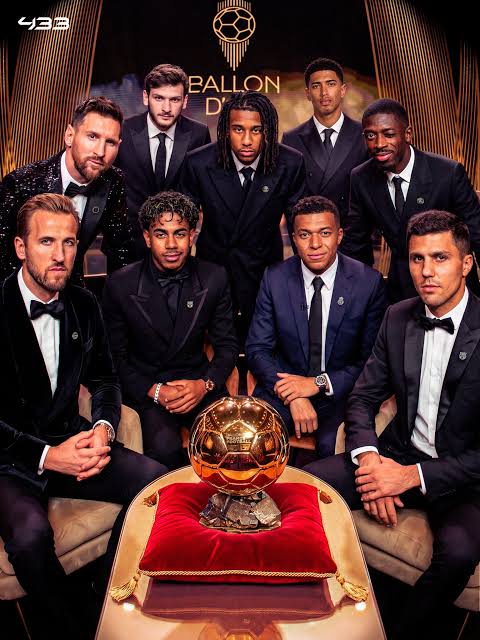
The Ballon d’Or is no longer simply a question of who was the best footballer. It has become a courtroom and in 2026, every superstar has brought evidence.
The Ballon d’Or conversation is heating up.
And Kylian Mbappé is not hiding.
The Real Madrid and France superstar has every reason to believe that this could finally be the year he gets his hands on the individual prize that has repeatedly escaped him.
His evidence is compelling.
Mbappé finished the 2026 World Cup as the tournament’s top scorer with 10 goals, taking his career World Cup tally to a record-breaking 22. He also produced another extraordinary scoring season for Real Madrid, giving him the kind of individual numbers that make it almost impossible to leave his name out of the conversation.
But there is one uncomfortable question hanging over his campaign:
Where are the trophies?
Real Madrid finished the 2025/26 season without a major trophy, while France fell short of World Cup glory.
And that is where the Ballon d’Or argument becomes fascinating.
Because Mbappé is not alone.
Harry Kane has goals and silverware.
Lamine Yamal has trophies, creativity and a World Cup winner’s medal.
Rodri has just won the World Cup and was named the tournament’s Golden Ball winner.
And PSG’s European success has created another argument altogether.
So what should actually decide the Ballon d’Or?
Individual brilliance?
Team success?
Big-game performances?
Or some combination of all three?
THE FIVE MEN WHO HAVE A CASE
- KYLIAN MBAPPÉ — THE INDIVIDUAL NUMBERS ARGUMENT
If the Ballon d’Or is supposed to identify the best individual footballer, Mbappé has perhaps the cleanest argument.
Ten World Cup goals.
22 World Cup goals in total.
A phenomenal club scoring record.
Elite pace.
Elite finishing.
Elite chance creation.
And the ability to take over matches almost single-handedly.
The 2026 World Cup strengthened his case enormously. He finished as the tournament’s Golden Boot winner despite France failing to win the competition.
This is where Mbappé’s supporters have a legitimate question:
If one player is clearly producing extraordinary individual numbers, should he lose an individual award simply because his teammates didn’t win enough trophies?
That argument deserves to be taken seriously.
Why Mbappé should win
Because his individual output is almost impossible to ignore.
He has consistently been one of the most productive attackers in world football, and his World Cup performance gave his candidacy an enormous global stage.
If the award is primarily about identifying the player who performed at the highest individual level, Mbappé has evidence.
Why Mbappé shouldn’t win
The problem is the trophy cabinet.
The strongest candidates around him have something Mbappé lacks this year: major collective achievements.
Real Madrid’s trophyless season weakens his case.
France also failed to win the World Cup.
And that creates a difficult comparison when players such as Kane, Yamal and Rodri can point to major team success alongside their individual performances.
Mbappé may have the biggest individual numbers.
But the Ballon d’Or has never existed in a vacuum.
- HARRY KANE — THE NUMBERS + TROPHIES ARGUMENT
Harry Kane’s 2026 case might be the most uncomfortable one for everybody else.
Why?
Because he has managed to combine something that is often difficult to combine:
ridiculous individual production and significant team success.
Kane had a sensational season for Bayern Munich, with reports putting his club goal tally at 61, while he helped Bayern secure domestic silverware. He then added six goals for England at the World Cup.
And suddenly, the player who spent years being questioned for his lack of major trophies has the opposite problem.
Now he has them.
Why Kane should win
Goals.
Goals.
And more goals.
But not just goals.
Kane has evolved into a complete attacking reference point — scorer, creator, link player and leader.
His 2025/26 season gave him the statistical argument, while Bayern’s success gave him the trophy argument.
That combination is extremely powerful.
Why Kane shouldn’t win
England did not win the World Cup.
And although Kane scored six times, his tournament ultimately ended without the biggest prize.
This matters because the World Cup carries extraordinary weight in a Ballon d’Or year.
There is also a legitimate question about whether Kane’s domestic success should outweigh the influence of players who dominated the world’s biggest international tournament.
Still, Kane’s case may be the hardest to dismiss.
- LAMINE YAMAL — THE “HE CHANGED GAMES” ARGUMENT
Then comes the phenomenon.
Lamine Yamal.
At just 19, the Barcelona and Spain star has already built a résumé that sounds almost fictional.
Barcelona’s success.
Individual recognition in Spain.
And now a World Cup winner’s medal.
Yamal was one of the central figures in Spain’s World Cup triumph, adding the biggest international trophy in football to an already extraordinary rise.
Why Yamal should win
Because sometimes football awards aren’t simply about counting goals.
They are about influence.
Yamal has become the player opponents fear, supporters expect and teammates look for when a match needs imagination.
He can create something from nothing.
He can change the rhythm of a game.
And unlike some contenders, he has the ultimate trophy to place beside his individual performances:
the World Cup.
Why Yamal shouldn’t win
Here is the problem:
The Ballon d’Or is supposed to reward a season, not a story.
And Yamal’s age, potential and extraordinary narrative cannot become substitutes for a complete body of work.
He has an enormous case.
But does he have a stronger individual season than Kane?
Than Mbappé?
Than Rodri?
That is the question.
If voters are swayed by the emotional power of a teenage World Cup winner, Yamal could benefit enormously.
But if they judge the entire season more coldly, the race becomes much tighter.
- RODRI — THE MIDFIELDER’S REVENGE
Rodri’s case is different.
He doesn’t necessarily dominate the conversation through spectacular goal totals.
He dominates games.
And in 2026, he has added something enormous to his résumé:
the World Cup.
Rodri was named the tournament’s Golden Ball winner as Spain lifted the trophy, strengthening the case for a second Ballon d’Or after his 2024 triumph.
Why Rodri should win
Because he represents something football awards have historically struggled to measure:
control.
The ability to make an entire team function.
The ability to dictate tempo.
The ability to make difficult football look ordinary.
Rodri’s World Cup was arguably the strongest individual tournament performance among Spain’s champions, according to the Golden Ball award.
And we have already seen that midfielders can win the Ballon d’Or when their influence becomes impossible to ignore.
Why Rodri shouldn’t win
The Manchester City part of his season complicates things.
His campaign was disrupted by injuries, and his club season was not as dominant as his previous Ballon d’Or-winning campaign. L’Équipe specifically noted that his City season was less complete because of those injuries.
So the argument becomes:
Can one magnificent World Cup outweigh a less convincing club season?
That is a legitimate reason to hesitate.
- KHVICHA KVARATSKHELIA — THE CHAMPIONS LEAGUE ARGUMENT
And here is where the Ballon d’Or debate gets really interesting.
Because while everyone is shouting about Mbappé, Kane, Yamal and Rodri, Khvicha Kvaratskhelia has a very serious European argument.
Paris Saint-Germain’s Champions League success matters.
A lot.
The Ballon d’Or has repeatedly rewarded players whose performances helped their clubs conquer Europe, and PSG’s European achievement cannot simply be ignored because the World Cup happened afterwards.
Kvaratskhelia is therefore one of the contenders who complicates the entire debate. He has been included among the leading names in current 2026 Ballon d’Or rankings, alongside the more obvious candidates.
Why Kvaratskhelia should win
Because the Champions League remains the highest level of club football.
If he was decisive in PSG’s European triumph, his supporters can legitimately argue that the Champions League should carry enormous weight.
After all, this is not a domestic cup.
This is Europe.
Why Kvaratskhelia shouldn’t win
The problem is simple:
The World Cup happened.
And players such as Rodri and Yamal have returned from the world’s biggest football tournament with the biggest prize available.
That gives them a platform Kvaratskhelia simply cannot reproduce.
SO… WHAT EXACTLY ARE WE REWARDING?
And this is where the Ballon d’Or needs to have a serious conversation with itself.
Because somewhere along the way, football has created an award that wants to be both an individual award and a team-success award.
Those two ideas don’t always fit comfortably together.
If individual brilliance is the primary criterion, then why should a player be punished because his teammates failed?
Imagine a striker scoring 50 goals while playing for a team that wins nothing.
Now imagine another player scoring 25 goals for a team that wins the Champions League and the World Cup.
Who was actually the better individual footballer?
That is not an easy question.
And it shouldn’t be.
THE BALLON D’OR WAS ONCE A DIFFERENT STANDARD
Think back to the great Ballon d’Or debates of the early 2000s through the Messi-Ronaldo era.
The standard was brutal.
Ronaldinho wasn’t merely entertaining — he was transformational.
Kaká wasn’t simply producing numbers — he was controlling Champions League nights.
Cristiano Ronaldo combined absurd athleticism, goals and decisive performances.
Lionel Messi eventually turned statistical excellence into something that almost looked impossible.
Xavi and Iniesta demonstrated that controlling football could be as valuable as scoring it.
And the debates weren’t always about who had the biggest spreadsheet.
They were about something deeper:
Who actually looked like the best footballer in the world?
That question remains the soul of the award.
But modern football has changed.
Statistics have exploded.
Social media has amplified every performance.
Goals and assists can be packaged instantly.
A spectacular 90 minutes can become a global argument before the final whistle has even been blown.
And suddenly the Ballon d’Or can feel less like an assessment of a football season and more like a referendum on the loudest narrative.
THE 2021 WARNING
The 2021 Ballon d’Or remains one of the clearest examples of why the debate is so difficult.
Lionel Messi won with 613 points, while Robert Lewandowski finished second with 580. Jorginho was third with 460.
It was incredibly close.
And the voting system itself shows how subjective the award can become: voters selected five players and awarded them 6, 4, 3, 2 and 1 points. First-place votes then became important in the event of a tie.
Messi had the Copa América.
Lewandowski had extraordinary numbers and another sensational Bayern campaign.
Jorginho had the Champions League and European Championship.
Three different definitions of greatness.
Three different arguments.
And one winner.
The lesson?
There has never been a perfectly objective Ballon d’Or.
But perhaps the standard should be clearer.
WHAT SHOULD THE STANDARD ACTUALLY BE?
Maybe the answer isn’t:
Individual performance OR trophies.
Maybe it should be:
- Individual performance
How good was the player?
- Big-game influence
Did he perform when the stakes were highest?
- Team achievement
What did his team actually win?
- Consistency
Was he brilliant for three months or brilliant for the entire evaluation period?
- Tactical influence
Did he simply accumulate numbers, or did he fundamentally change how his team played?
- Context
How difficult was it to produce those performances?
That final point is particularly important.
A 30-goal season for one player may not be equivalent to another player’s 30-goal season.
Football is context.
SO WHO SHOULD WIN THE 2026 BALLON D’OR?
If you prioritise pure individual production, Mbappé has a monster case.
If you prioritise goals + trophies, Kane becomes extremely difficult to beat.
If you prioritise World Cup glory + creativity + influence, Yamal enters the conversation.
If you prioritise control + World Cup dominance, Rodri has perhaps the strongest midfielder’s argument.
And if you believe Champions League success should carry enormous weight, PSG’s stars cannot be dismissed.
That is precisely why this year’s race is so fascinating.
Current rankings and betting markets have Kane, Yamal, Rodri and Mbappé among the leading candidates, but there is no consensus winner.
And perhaps that is exactly how it should be.
THE NISTYFOOTBALL QUESTION
Forget the names for a moment.
Forget Mbappé.
Forget Kane.
Forget Rodri.
Forget Yamal.
Ask yourself this:
If Player A scores 50 goals, creates 20 assists and wins nothing…
while Player B scores 30 goals, creates 15 assists and wins the Champions League and World Cup…
who deserves the Ballon d’Or?
If you choose Player B, you are saying football is ultimately about winning.
If you choose Player A, you are saying an individual should not be punished for the failures of his teammates.
And if you say “it depends”, congratulations.
You’ve just discovered why the Ballon d’Or debate will never die.
Because the award is trying to answer a question football itself has never been able to settle:
Is greatness about what you achieve — or how brilliantly you play while trying to achieve it?
The answer will be decided in London on October 26.
But the argument has already begun.
The Ballon d’Or isn’t just a trophy anymore — it’s a courtroom, and every superstar has brought evidence.
Mbappé has goals.
Kane has goals and trophies.
Yamal has youth, brilliance and a World Cup.
Rodri has control and another World Cup triumph.
And the Champions League winners have Europe in their evidence file.
So now the jury must decide:
What matters more — the numbers, the trophies, the big moments, or the player who simply looked like the best footballer on the planet?
The verdict is coming.
Gallery
More from this story
Read next
Stories you should not miss

Breaking
Silenced? Martínez's Apology Smells Like a Club in Damage Control, and INEOS Has Questions to Answer
Breaking
Licha Drops the Mask: Martínez Exposes United's Rotten Core, But the Dressing Room Isn't Innocent
Breaking
Man City Found Guilty. Two Weeks Later: "94% of Clubs Are Losing Money." Coincidence?
Published Tuesday, 8 September 2026. Published through the Nisty Football newsroom.
Fan reaction
Comments (1)
Leave a comment
No account needed · 0 approved
0/1500 characters · comments are reviewed before publication
More from Nisty Football
Related stories
A Man Up, a Goal Ahead, Yet No Victory: Has Michael Carrick Run Out of Answers at Manchester United?
is Carrick struggling to find the answers, or are Manchester United’s problems deeper than their manager?
Are Premier League Rules Only for the Clubs Without Billionaire Owners?
Manchester City’s 115 charges and the prolonged wait for resolution raise serious questions about financial fairness, accountability, and the Premier League’s credibility.
WHAT FIFA KNEW BEFORE NIGERIA LOST TO DR CONGO
The Super Eagles’ defeat to DR Congo was painful enough. The revelations surrounding Lionel Mpasi’s eligibility have turned that heartbreak into a much bigger question about football’s governing system.
What Messi’s Farewell Tells Us About Ronaldo’s Unfinished Story
And now, as their international careers approach their final chapters, perhaps the most fascinating comparison is no longer about what they achieved. It is about how their stories are ending.”