Como’s 9-1 Masterclass Was No Accident: The Project Behind Their Rise to the Champions League
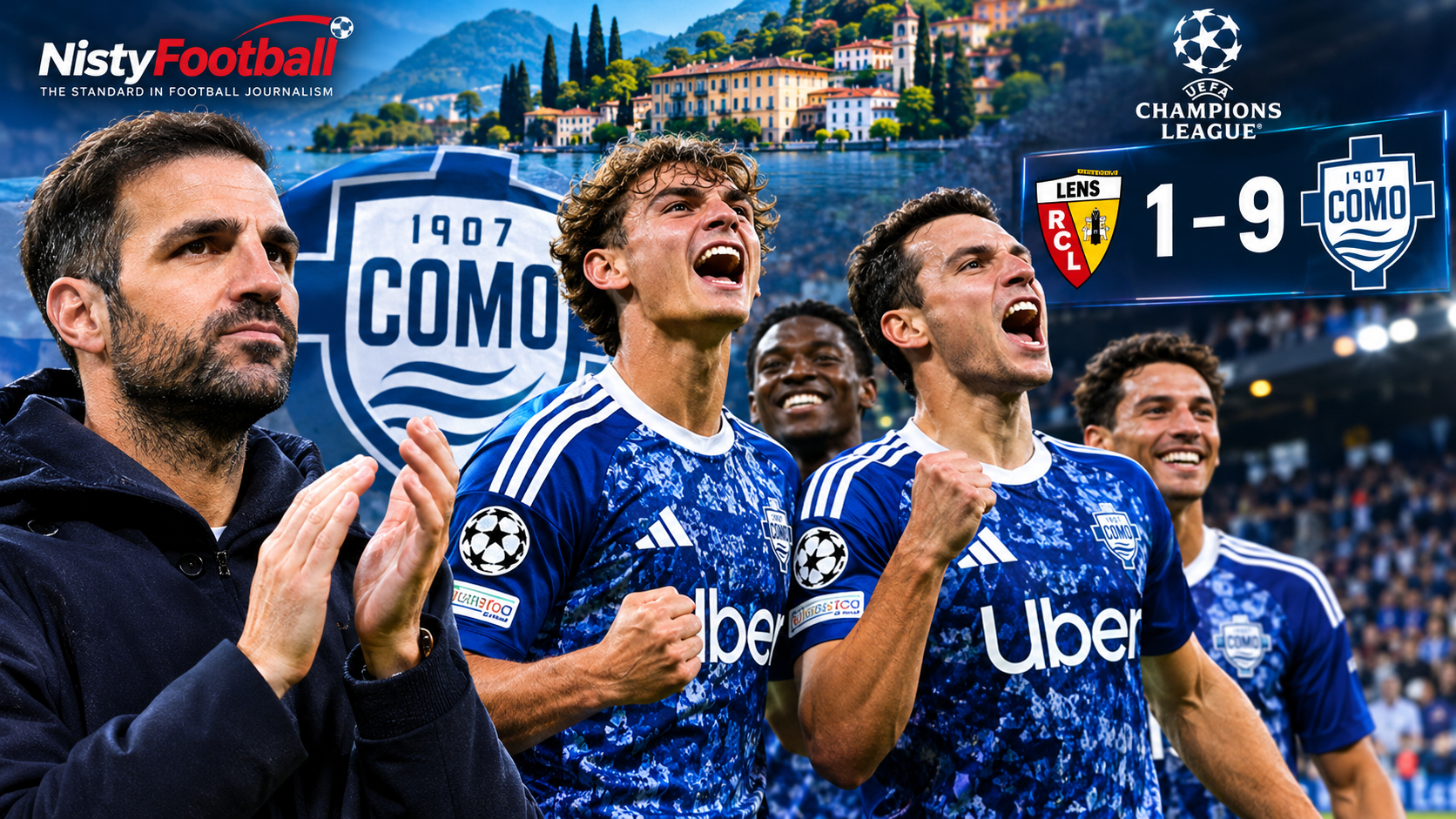
Como’s rise is no accident. Behind their stunning 9-1 victory over Lens lies a carefully built football project driven by ambitious ownership, Cesc Fàbregas’ vision and a commitment to sustainable growth.
Como’s 9-1 Masterclass Was No Accident: The Project Behind Their Rise to the Champions League
By FRANKLIN EGELONU
There was a time when Como were fighting for survival in the lower divisions of Italian football, a club whose ambitions appeared far removed from the grand stages of European competition.
On Wednesday, November 4, 2026, that distance felt almost impossible to imagine. At the Stade Bollaert-Delelis in France, Cesc Fàbregas’ side dismantled Lens 9-1, producing one of the most remarkable scorelines in Champions League history.
Anastasios Douvikas led the destruction with a hat-trick, while six other players also found the net. Como equalled the competition’s biggest winning margin, but the significance of the evening extended well beyond the numbers on the scoreboard.
Nine goals will inevitably dominate the headlines. Yet the more compelling story is how a club that once found itself outside Italy’s professional football structure has developed into a Champions League contender.
Como’s extraordinary rise has been built on ambitious ownership, deliberate investment, a developing football infrastructure, an emphasis on player development and a manager whose tactical philosophy has given the team a recognisable identity.
Their demolition of Lens was not simply an evening when everything went right in front of goal. It was the latest demonstration of a project that has been taking shape for years.
FROM BANKRUPTCY TO SERIOUS AMBITION
To understand the scale of Como’s achievement, it is important to appreciate just how far the club has travelled.
Financial difficulties and bankruptcy once left Como outside Italy’s professional league structure. Following their exclusion from the competition, the club were forced to restart in Serie D, the country's fourth tier, in the 2017/18 season.
The turning point came on April 4, 2019, when Como were acquired by SENT Entertainment, a London-based media and entertainment company associated with Indonesia’s Hartono family and their wider Djarum business group.
The new ownership brought financial resources, but its ambitions were never limited to spending money on the first team. The intention was to establish a stronger institution, one capable of supporting sustained sporting growth.
According to the club’s official history, the development priorities included financial stability, a stronger corporate structure and investment in the first team, youth academy, sporting infrastructure and stadium.
That broader vision began producing results.
Como won Serie D in the 2018/19 campaign, setting a league points record, before moving into Serie C. They subsequently won promotion to Serie B after claiming the Serie C title in 2020/21.
However, the journey through the second division demanded patience. Como spent three consecutive seasons in Serie B before finishing second in 2023/24 with 73 points, securing their return to Serie A after a 21-year absence.
Their progress did not stop there.
In the 2025/26 Serie A campaign, Como finished fourth with 71 points, recording 20 victories and scoring 65 goals. That achievement secured the club’s first-ever qualification for the Champions League.
For a team that had been rebuilding in the fourth tier only a few years earlier, the transformation was extraordinary.
There is also a commercial dimension to the ownership's ambitions. Rather than viewing Como strictly as a football investment, the owners have sought to connect the club with the international appeal of Lake Como through tourism, travel experiences, fashion, retail and media.
Reuters reported that the ownership group viewed the city itself as a significant part of the wider business opportunity.
That distinction matters. The ambition is not simply to assemble a team capable of competing at the highest level. It is to build an organisation whose commercial and sporting foundations can sustain that ambition.
FÀBREGAS: THE FOOTBALLING THINKING BEHIND THE PROJECT
Financial investment can attract talented footballers, but it cannot automatically create a coherent team. Money may accelerate recruitment, but it does not guarantee tactical understanding, collective organisation or a recognisable playing identity.
This is where Cesc Fàbregas becomes central to Como’s story.
The former Barcelona, Arsenal and Chelsea midfielder joined the club as a player in 2022 before gradually moving into coaching. He was involved in the club’s promotion campaign and officially became head coach in July 2024 on a four-year contract.
His footballing philosophy is built around positional play, controlled possession and intelligent movement.
Como generally operate from a 4-2-3-1 structure, although their shape changes depending on the phase of the game. The formation is less important than the relationships between the players and the spaces they attempt to occupy.
During the initial build-up, one of the two defensive midfielders can drop closer to the centre-backs, creating an additional passing option and helping the team progress the ball.
As possession advances, the full-backs are encouraged to push forward, while the wide attackers can move into narrower positions. This creates a tactical relationship designed to give Como numerical advantages in central areas.
When a full-back advances, the winger on that side can occupy the half-space, while the attacking midfielder looks for opportunities between the opposition’s midfield and defensive lines.
The objective is to give the player in possession multiple passing options, make it difficult for opponents to maintain their defensive shape and create openings for forward passes.
Nico Paz has become particularly valuable within this structure. His ability to receive between the lines, turn under pressure and find forward passes gives Como an important connection between midfield and attack.
Crucially, Fàbregas' approach is not about possession for possession's sake. The intention is to use the ball to manipulate the opposition, draw defenders away from their positions and attack the spaces that subsequently become available.
Their attacking statistics reflect that ambition. During the 2024/25 Serie A season, Como ranked fourth for through balls, highlighting their willingness to penetrate defensive lines rather than simply recycle possession.
Without the ball, the approach changes.
Fàbregas frequently organises his team into a 4-4-2 pressing structure, with the attacking midfielder moving alongside the striker to form the first line of pressure.
Behind them, the midfield becomes more compact, restricting central passing options and encouraging opponents towards the touchline. The wingers and full-backs can then work together to press the player receiving possession in those wider areas.
It is an aggressive approach that demands coordination, concentration and considerable physical commitment.
There are, however, risks.
When a defensive midfielder drops between the centre-backs, Como can become vulnerable if possession is lost before the players ahead of the ball recover their positions. Similarly, pushing the full-backs forward can leave spaces for opponents to exploit during transitions.
These vulnerabilities are an important part of understanding Fàbregas’ football. His attacking ambition requires excellent positional awareness, defensive organisation and significant work from the midfield.
The system offers considerable attacking possibilities, but its success depends on the collective ability to manage the spaces it creates.
WHAT THE 9-1 VICTORY ACTUALLY REVEALED
The destruction of Lens provided an extraordinary illustration of what Como’s attacking structure can produce when its different elements work together.
They finished the match with 57 per cent possession, attempted 18 shots and registered 12 on target. They also recorded 31 touches inside the opposition’s penalty area.
Those numbers tell a more interesting story than possession alone. Como were not simply enjoying control of the ball; they were repeatedly finding ways to move into dangerous areas and turn their territorial advantage into clear attacking opportunities.
The distribution of goals and assists was equally revealing.
Douvikas received assists from Máximo Perrone and Álex Valle for his first two goals before providing the final pass for Nico Paz’s strike.
Paz subsequently created opportunities for Lucas Da Cunha and Douvikas, while Luis Milla supplied the assist for Marc-Oliver Kempf.
The contributions continued from other areas of the squad. Jacobo Ramón assisted Mattia Liberali, while Liberali later provided the final passes for Martin Baturina and Matteo Papaccioli.
Seven different Como players registered assists.
That is significant because it demonstrates the collective nature of their attacking production. Como were not dependent on one individual to create opportunities or provide the decisive pass. Their threat came from different areas of the pitch, with multiple players contributing to the final action.
It also reflects the importance of the positional relationships within Fàbregas’ system. When players understand where to move, when to advance and how to exploit the spaces created by their teammates, attacking responsibility becomes shared rather than concentrated in one individual.
The substitutes made that point even more convincingly.
Liberali, Baturina and Papaccioli all scored after entering the game, showing that Como's attacking intensity was not limited to the starting eleven.
For a club competing in European football, that is an encouraging sign. A strong starting team can win matches, but squad depth is what allows a project to remain competitive across an increasingly demanding season.
Papaccioli's contribution deserves particular attention.
The 18-year-old midfielder, who came through Como's youth academy, made his European debut before scoring the ninth goal in stoppage time.
One appearance cannot establish the success of an entire academy programme. However, the moment provided a meaningful example of the pathway Como are attempting to create between youth development and first-team football.
It also brings attention to the club’s decision to appoint Osian Roberts as Head of Development. His responsibilities include establishing a common footballing culture, improving coach education and overseeing player-development plans.
These are not decisions made simply to improve the next match. They are structural investments intended to influence how the club develops players, coaches and its overall footballing identity.
THE REAL TEST OF COMO'S PROJECT
For all the excitement surrounding their rise, Como must recognise that reaching the Champions League and establishing themselves as a permanent force in European football are two very different challenges.
Their progress has been remarkable, but the most difficult stage of the project may still lie ahead.
They must maintain their recruitment standards, continue developing their academy, improve their infrastructure and provide Fàbregas with sufficient squad depth to manage the demands of domestic and European competition.
Their proposed redevelopment of Stadio Giuseppe Sinigaglia, announced in collaboration with the Municipality of Como and architectural firm Populous, represents another important part of the long-term vision.
A modern football club requires more than a talented squad. Its facilities, commercial operations, youth development structures and matchday environment must grow alongside its sporting ambitions.
There is also a tactical challenge.
As Como become more established, opponents will study their possession patterns, pressing triggers and positional rotations. Teams will look for ways to disrupt their preferred style, exploit the spaces left behind by advancing full-backs and prevent players such as Nico Paz from receiving comfortably between the lines.
Fàbregas will need to demonstrate that his ideas can evolve. Tactical identity is important, but the ability to adapt when opponents find solutions is what separates an exciting team from a consistently successful one.
The wider question concerns the relationship between investment and sustainable success.
Financial resources can accelerate a club's development, but the strongest projects eventually become capable of producing their own players, maintaining competitive standards and preserving a consistent identity even when circumstances change.
That is the challenge Como must now embrace.
Their 9-1 victory over Lens was extraordinary, but the real achievement is the journey that made such a performance possible.
From restarting in Serie D following bankruptcy to qualifying for the Champions League, Como have demonstrated what can happen when ownership ambition, sporting planning, infrastructure development and coaching philosophy begin working towards the same objective.
They have moved beyond the stage of being an interesting underdog story. They are now a club whose ambitions will be measured against the expectations of European football.
The next chapter will determine whether they can turn this remarkable rise into lasting success.
For Como, the nine goals against Lens may be remembered as the night they announced themselves to Europe. But the true measure of their project will not be how often they produce historic scorelines.
It will be whether they can continue competing at this level long after the celebrations of that extraordinary night have ended.
Read next
Stories you should not miss

Related stories
Published Friday, 6 November 2026. Published through the Nisty Football newsroom.
Enjoyed it? Tell us — and pass it on
The discussion
What do you think? (0)
Leave a comment
No account needed · 0 approved
0/1500 characters · comments are reviewed before publication
The Daily Kick-off
Football in your inbox, every morning at 7am
One email: the overnight transfer moves, the tactical story of the night, and every fixture that matters today. No noise, no clickbait.
More from Nisty Football
Related stories

Ronaldo’s Record in Sight: Can Harry Kane Turn Champions League Goals Into Ballon d’Or Glory?
Nine games, 11 goals, and a spot in Champions League history: Harry Kane passes Lionel Messi, setting his sights on Cristiano Ronaldo's ultimate European record and making a compelling late bid for the Ballon d'Or.
Chelsea Had the Ball, Leeds Had the Game: How Farke's Side Turned Possession Into a Nightmare
Chelsea enjoyed more possession but Leeds United dominated the decisive moments, producing a ruthless 4–1 victory at Stamford Bridge through intelligent transitions and clinical finishing.

How Newcastle’s Triple Substitution Turned Arsenal’s Advantage Around
Newcastle's second-half transformation against Arsenal demonstrated the importance of tactical flexibility, with Matthias Jaissle's triple substitution changing the momentum of an entertaining 2-2 encounter.

The MLS Pressure Debate: Are Son and Müller Right About US Football?
LAFC forward Son Heung-Min has backed Thomas Müller's critique of the MLS, reigniting a fierce debate over franchise football, promotion and relegation, and whether American soccer lacks true stakes.