Italy 3–1 France: How Mancini's Tactical Changes Turned the Game Around
France dominated possession, but Italy dominated the decisive moments. Pio Esposito's brace, Frattesi's clinical finish and Mancini's inspired substitutions delivered a remarkable 3-1 comeback victory at San Siro.
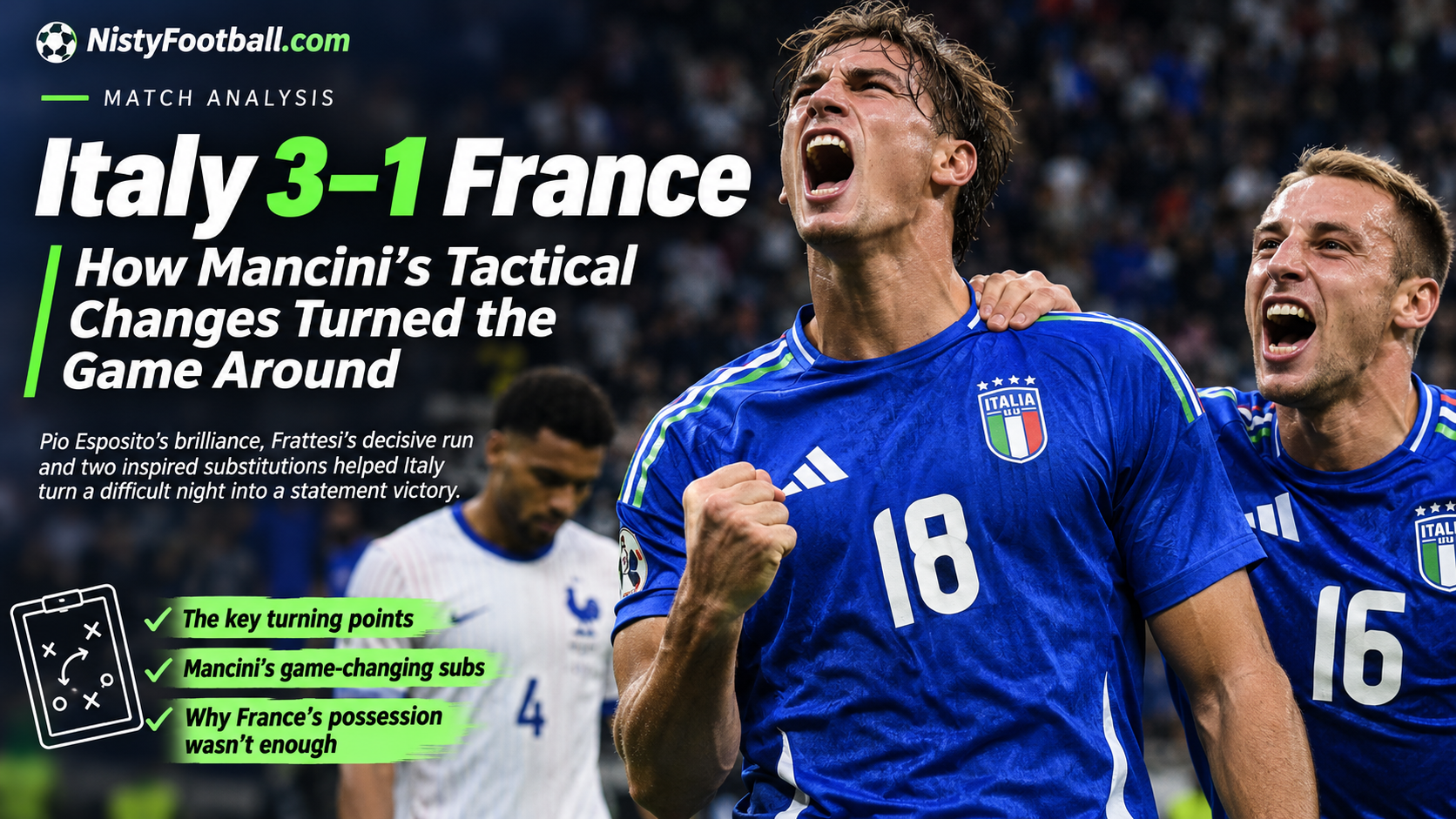
Italy 3–1 France: How Mancini's Tactical Changes Turned the Game Around
Pio Esposito's brilliance, Frattesi's decisive run and two inspired substitutions helped Italy turn a difficult night against France into a statement victory.
For almost an hour at San Siro, France looked like the team in control. They pressed with purpose, moved the ball confidently and repeatedly threatened to expose Italy's defensive weaknesses. Italy, meanwhile, looked uncomfortable, struggled to establish control and spent long spells trying to contain their opponents.
Yet when the final whistle sounded, the scoreboard told a completely different story: Italy 3, France 1.
This was more than a comeback victory. It was a demonstration of how a team can overcome an opponent's territorial dominance through tactical intelligence, effective substitutions and clinical execution.
Italy did not need to outplay France in every department. They needed to survive their opponents' strongest spell, recognise where the opportunities were and make the right adjustments. Roberto Mancini's intervention after the hour mark proved decisive, but the foundations of the comeback had been laid much earlier.
Donnarumma's Mistake Gave France the Start They Wanted
France did not have to wait long for an opportunity to take control of the contest.
In the 10th minute, Gianluigi Donnarumma attempted to play out from the back but made a costly mistake, allowing Michael Olise to capitalise and put France ahead.
The goal was particularly damaging because it rewarded exactly what France had been trying to achieve: aggressive pressure on Italy's first phase of possession.
France sensed an opportunity and continued to attack. Bradley Barcola came close to doubling their advantage when a rapid counter-attacking move ended with his effort striking the post.
Italy were not simply struggling to retain possession. They were struggling with what happened immediately after losing it. France's ability to turn defensive recoveries into dangerous attacking situations left the Italian backline exposed and forced the hosts into a reactive approach.
For Mancini, the immediate challenge was to prevent the game from slipping beyond Italy's reach.
Pio Esposito Changed Italy's Mood
Italy needed a response, and Francesco Pio Esposito provided it.
In the 26th minute, Nicolò Cambiaghi produced an excellent attacking move down the flank before delivering a low cross into the penalty area. Esposito attacked the ball ahead of Dayot Upamecano and finished to restore parity.
It was a goal that changed more than the scoreline.
Until then, Italy had been forced backwards, allowing France to dictate the rhythm and direction of the game. The equaliser gave the hosts something they had been missing: belief.
It also highlighted an important attacking detail. Esposito was willing to attack the space between France's centre-backs rather than remain static and wait for the ball. His movement gave Italy a direct option and a way to punish France when their defensive structure was stretched.
The equaliser did not suddenly make Italy the better team, but it gave them a foothold in a contest that had threatened to get away from them.
France continued to create opportunities, and Italy still had plenty of work to do.
Donnarumma's Redemption and Sebastiano Esposito's Missed Opportunity
The opening stages of the second half offered a reminder of just how dangerous France could be.
Rayan Cherki created two opportunities, with the second requiring a crucial intervention from Donnarumma. The Italian goalkeeper reacted sharply to turn Cherki's effort onto the post.
It was an important moment of redemption.
The same goalkeeper whose mistake had gifted France the opening goal had now prevented them from restoring their advantage. In a match where the margins were becoming increasingly important, that save kept Italy alive.
Then came another opportunity to change the direction of the contest.
Italy were awarded a penalty after Cambiaghi was brought down in the area. Sebastiano Esposito stepped forward, but his effort went wide.
It was a potentially costly miss. Italy had an opportunity to take the lead without having to break down France in open play, but the chance disappeared.
For a moment, the game threatened to swing back towards France. Instead, Mancini made the intervention that changed everything.
Mancini's Substitutions Were the Turning Point
In the 61st minute, Mancini introduced Federico Dimarco and Antonio Vergara, replacing Cambiaghi and Sebastiano Esposito.
On the surface, these might have appeared to be straightforward attacking changes. In reality, they gave Italy different qualities at precisely the right moment.
Dimarco offered a different attacking threat from the left, particularly through his ability to deliver early, dangerous balls into the penalty area. Vergara brought fresh energy, movement and the willingness to carry the ball into spaces that were becoming increasingly difficult for France to protect.
The significance of the changes was not simply that two fresh players entered the pitch. It was that Italy now had different ways to attack the spaces behind France's advancing defensive structure.
And the impact was almost immediate.
Just two minutes after coming on, Dimarco delivered a low cross into the box. Davide Frattesi arrived at the right moment and finished to put Italy ahead 2–1.
Suddenly, a match France had largely controlled had turned in Italy's favour.
Frattesi's Goal Exposed France's Biggest Problem
The goal was an excellent example of how to punish a team that commits players forward and leaves spaces behind.
France were comfortable when Italy were forced to build slowly under pressure. They could press, squeeze the available space and make life difficult for the hosts.
But when Italy bypassed that pressure and attacked quickly, France looked far less comfortable.
Dimarco's delivery arrived before the French defence could completely reorganise itself. Frattesi, whose ability to arrive late in the penalty area is one of his greatest strengths, attacked the available space and finished clinically.
Italy did not need to dominate possession to create that opportunity. They needed to recognise the moment to move forward and execute the attack before France could recover their defensive shape.
That was the difference.
The goal also demonstrated the value of intelligent substitutions. Mancini did not merely introduce fresh legs; he introduced players whose qualities directly addressed the spaces and opportunities the game was beginning to offer.
Pio Esposito Turned a Good Night Into a Statement
France now had to chase the game, and that created even more opportunities for Italy to exploit.
The visitors were forced to commit more players forward, increasing the spaces available for Italy's counter-attacks.
Vergara became involved in the move that eventually produced Italy's second penalty. This time, Pio Esposito stepped forward.
Unlike his older brother, the young striker made no mistake. He converted in the 75th minute to make it 3–1 and effectively put the contest beyond France.
It completed a remarkable individual performance.
Esposito had already scored the equaliser that restored Italy's confidence. Now he had delivered the decisive third goal, demonstrating the composure and attacking instincts required of a top international striker.
According to the Italian Football Federation, the brace took his international tally to nine goals in just 14 appearances.
For a 21-year-old striker, those are impressive numbers. More importantly, his performance showed that Italy may have found a centre-forward capable of becoming central to their future.
France's Changes Came Too Late
Zinedine Zidane eventually responded with a series of substitutions, introducing fresh players in an attempt to change the direction of the match.
However, by then, France were already two goals behind.
The changes brought energy, but they could not solve the underlying tactical problem. France still had more of the ball, but Italy were now defending a two-goal advantage with greater confidence and discipline.
Every French attack also carried a risk. The more players Zidane committed forward, the more space Italy could find behind them.
France's possession had become less threatening because Italy no longer needed to chase the game or force themselves into unnecessary attacking situations.
They could defend, wait for opportunities and punish any further mistakes.
The Numbers Tell Two Different Stories
The statistics from the match make Italy's victory even more interesting.
France finished with 64.9% possession compared with Italy's 35.1%. They also recorded 18 shots to Italy's 11 and completed 541 accurate passes against Italy's 252.
Yet both teams registered five shots on target, and Italy scored three times.
| Match statistic | Italy | France | |---|---:|---:| | Possession | 35.1% | 64.9% | | Total shots | 11 | 18 | | Shots on target | 5 | 5 | | Big chances missed | 1 | 3 | | Accurate passes | 252 | 541 | | Passing accuracy | 80% | 91.9% | | Touches in opposition box | 19 | 36 | | Interceptions | 15 | 8 | | Clearances | 31 | 14 | | Saves | 4 | 2 |
The numbers illustrate two different approaches to the game.
France enjoyed greater territorial control, circulated the ball more frequently and attempted more shots. Italy, however, were more effective when opportunities presented themselves.
This is an important distinction in modern football. Possession can help a team control the rhythm of a match, but it does not automatically translate into meaningful control of the outcome.
Italy understood that they did not need to win the possession battle. They needed to make their moments count.
The Real Lesson From Italy's 3–1 Victory
Italy's victory came down to four important factors: Pio Esposito's efficiency, Mancini's tactical adjustments, the team's ability to survive France's strongest periods and France's inability to turn possession into enough decisive opportunities.
Italy did not beat France by taking the ball away from them for long periods. They beat France by making their possession less dangerous.
This was not a match in which Italy simply dominated their opponents. They did not. France controlled much of the game territorially and created enough opportunities to make the contest uncomfortable.
What Italy did better was adapt.
They survived the early pressure, found a way back into the match, introduced Dimarco and Vergara at the right moment, attacked the spaces behind France's defence and finished the opportunities that came their way.
For Mancini, it was a victory that demonstrated the importance of reading a game and making changes before the opposition can fully adjust.
For Pio Esposito, it was another major step forward in his international career.
And for Italy, it was a reminder that tactical intelligence, discipline and efficiency can be just as valuable as dominating possession.
France had 64.9% of the ball. Italy had three goals.
At San Siro, that was the difference.
Read next
Stories you should not miss


Related stories

Published Saturday, 14 November 2026. Published through the Nisty Football newsroom.
Enjoyed it? Tell us — and pass it on
The discussion
What do you think? (0)
Leave a comment
No account needed · 0 approved
0/1500 characters · comments are reviewed before publication
The Daily Kick-off
Football in your inbox, every morning at 7am
One email: the overnight transfer moves, the tactical story of the night, and every fixture that matters today. No noise, no clickbait.
More from Nisty Football
Related stories
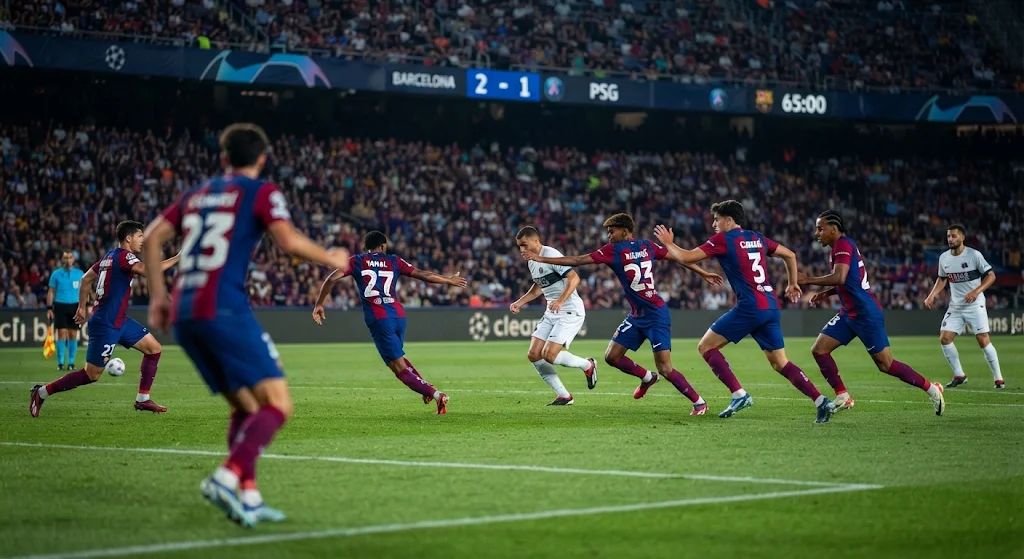
Hansi Flick’s High-Wire Act: How Barcelona’s Aggressive Press Dominates La Liga—And Risks the Champions League
Averaging four goals a game in La Liga while sitting 5th in the Champions League, Hansi Flick’s Barcelona are Europe’s most thrilling—and polarizing—side. We break down how their offside trap and relentless counter-pressing work, and where elite opponents exploit them.
Portugal's Post-Ronaldo Reality Check as Denmark Hand Them 4–1 Defeat
Portugal's first match following Cristiano Ronaldo's international retirement ended in disappointment as Denmark secured a convincing 4–1 Nations League victory in Braga, raising fresh questions about the Seleção's future.
The Pressing Trap: How Football’s Most Fearsome Weapon Can Become Its Biggest Weakness
High pressing can suffocate opponents, force mistakes and create goalscoring opportunities. But what happens when the press is beaten? From Manchester City's defensive struggles to Benfica's tactical discipline and Guardiola's solutions against Arsenal, we examine how football's most aggressive defensive weapon can quickly become its biggest weakness.

Arsenal 1–0 Hull City: How Arteta's Tactical Changes Finally Broke Hull's Resistance
Arsenal dominated possession but struggled to find a breakthrough against Hull City. Mikel Arteta's tactical adjustments, attacking substitutions and Martin Ødegaard's decisive finish eventually secured a hard-fought 1-0 victory.