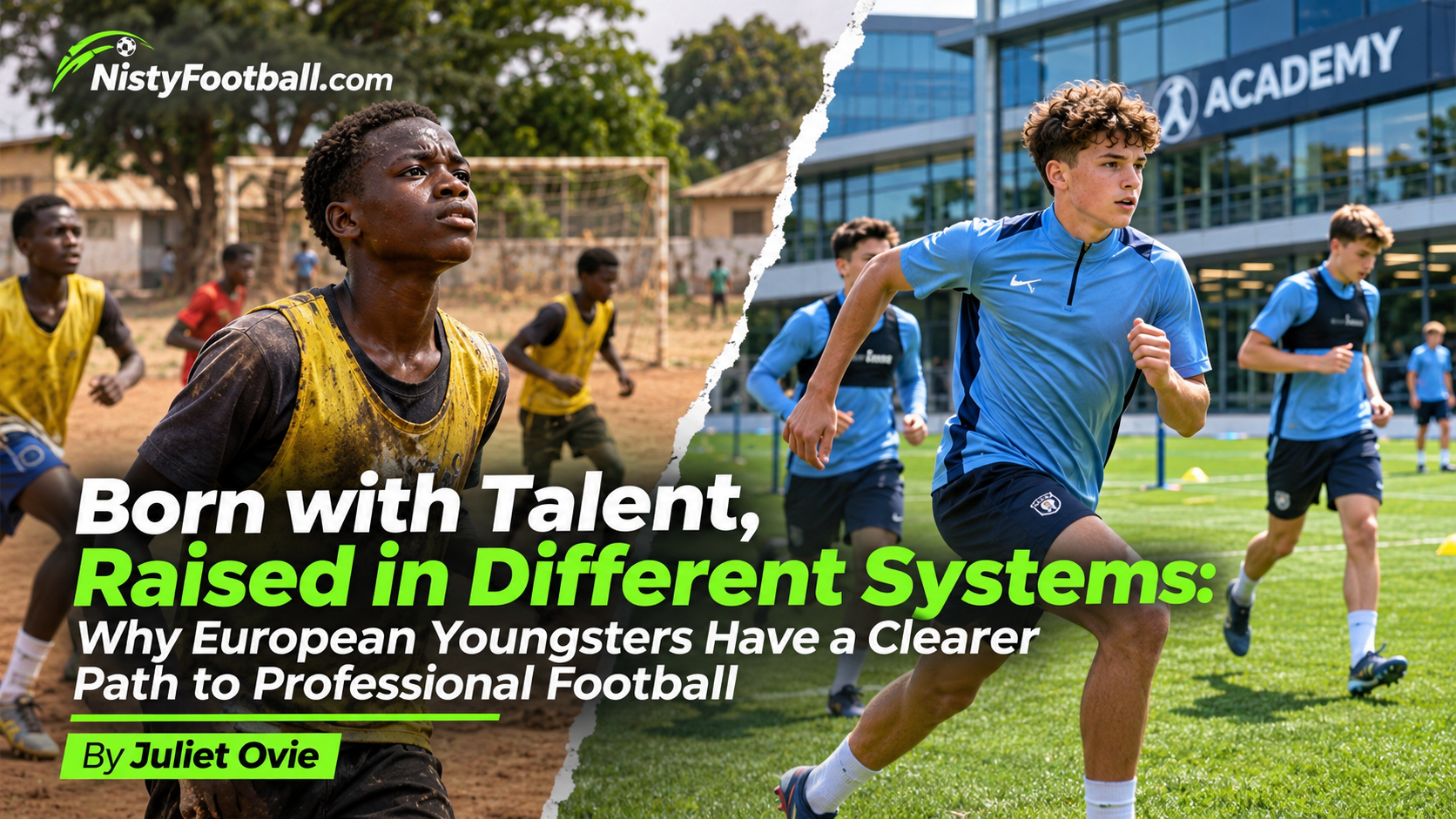
Born with Talent, Raised in Different Systems: Why European Youngsters Have a Clearer Path to Professional Football
Africa has the talent, but does it have the system to nurture it? Juliet Ovie explores why European youngsters enjoy a clearer route to professional football and what African football must change to unlock its next generation of stars.
Born with Talent, Raised in Different Systems: Why European Youngsters Have a Clearer Path to Professional Football
By Juliet Ovie
Football talent knows no borders. From the dusty pitches of West Africa to the well-manicured training grounds of Europe, young players continue to demonstrate the technical brilliance, creativity, pace and determination required to compete at the highest level.
Across Africa, countless youngsters dream of becoming professional footballers. Some possess extraordinary natural ability, others display remarkable discipline and determination, while many combine both. Yet, despite having the qualities needed to succeed, their journey towards professional football is often considerably more difficult than that of their European counterparts.
Why?
The answer may not lie in who possesses more talent, but in who receives better opportunities to develop it.
While European football has established structures that guide young players from grassroots competitions into professional academies, many African youngsters must overcome obstacles that have little to do with their ability on the pitch. Inadequate facilities, limited funding, inconsistent competitions and restricted scouting opportunities continue to stand between promising African talents and their professional ambitions.
This raises an important question: Are European youngsters better footballers, or have they simply been given better environments in which to become better?
Facilities: Where the journey to greatness begins
Talent may be natural, but developing it requires the right environment.
Across countries such as England, Germany, Spain and France, professional football clubs invest heavily in youth academies designed to identify, nurture and develop promising players. These facilities often feature quality training pitches, modern equipment, gyms, medical departments, recovery centres and sports science specialists.
At clubs such as Barcelona and Manchester City, youth development extends far beyond teaching youngsters how to pass, shoot or dribble. Players are introduced to structured training programmes that monitor their physical development, tactical understanding, technical abilities and overall progress.
This approach ensures that development is not left to chance. Every training session, assessment and competitive opportunity forms part of a broader plan to prepare young footballers for the demands of professional football.
Unfortunately, the picture is considerably different for many aspiring footballers across Africa.
In several communities, youngsters still train on poorly maintained pitches, often without adequate equipment or access to qualified medical personnel. Some play barefoot or share limited training facilities with dozens of other aspiring footballers. Injuries that could be identified and managed early may become serious setbacks because proper medical support is unavailable.
It would, however, be unfair to suggest that Africa has no quality football development structures.
Ghana's Right to Dream Academy and Senegal's Génération Foot are excellent examples of what can be achieved through investment, planning and a clear development philosophy. They demonstrate that African youngsters can receive quality football education without necessarily having to leave the continent.
The challenge is that such opportunities remain inaccessible to a significant number of aspiring players.
Coaching and education: Developing the footballer and the individual
A good training facility is important, but the quality of coaching determines how effectively a young player develops.
In established European academy systems, coaching programmes are generally organised around the different stages of a player's development. Youngsters are taught technical skills, tactical awareness, positional responsibilities, decision-making and physical conditioning according to their age and ability.
They are not simply encouraged to win matches. They are taught how to understand the game, make better decisions and adapt to different tactical situations.
UEFA's club licensing framework also reinforces the importance of structured youth development by establishing requirements relating to coaching, infrastructure, medical support and education.
Across Africa, coaching standards vary considerably between countries, communities and academies. There are talented and knowledgeable coaches throughout the continent, but many grassroots programmes lack the financial resources to employ specialists, access modern training equipment or provide regular coaching education.
This creates a difficult situation in which a youngster's development may depend heavily on the experience, resources and knowledge of whoever happens to be coaching them.
Education is another important part of the equation.
Right to Dream in Ghana offers a particularly strong example of how academic learning can be combined with elite football development. Its philosophy recognises that a young person's future should not depend entirely on whether they eventually become a professional footballer.
This is particularly important because professional football is an uncertain career. Thousands of youngsters pursue the dream, but only a small percentage make it to the top.
Providing players with quality education alongside football training gives them an alternative future and equips them with life skills that remain valuable even if their sporting ambitions do not materialise.
Ultimately, developing a footballer should also mean developing the individual behind the boots.
Scouting and exposure: Who gets the opportunity to be discovered?
One of the biggest advantages European youngsters enjoy is access to established talent-identification networks.
Across Europe, young players can be spotted through school competitions, grassroots leagues, regional tournaments and organised youth competitions. Professional clubs have scouting structures that allow them to monitor promising players across different age groups and locations.
This means a talented teenager playing for a relatively small local club can still attract attention from a professional academy.
For many African youngsters, however, getting noticed can be a completely different challenge.
Thousands of talented players compete in informal football environments where their performances may never reach professional scouts. Some are located in rural communities far from major football centres, while others lack access to organised competitions that could provide a platform to showcase their abilities.
Even when a youngster possesses exceptional talent, geographical distance, financial limitations and inadequate scouting networks can prevent that talent from receiving the recognition it deserves.
FIFA's 2022 Global Report on Talent Development identified inadequate planning, infrastructure, education and financial resources as some of the factors responsible for talented players going undiscovered around the world. The report reinforces the importance of structured identification systems that give youngsters a fair opportunity, regardless of where they come from. FIFA
The journey of Senegalese forward Sadio Mané illustrates how access to the right development pathway can transform a promising career.
Mané developed at Génération Foot before moving to French club FC Metz, opening the door to European football and eventually the highest levels of the professional game.
His story demonstrates the importance of partnerships between African academies and established European clubs. Such relationships can provide talented youngsters with access to better facilities, competitive opportunities and international exposure.
However, these pathways remain limited compared with the extensive recruitment and scouting networks available to many European youngsters.
The issue is not necessarily that African players are difficult to find. It is that the systems required to find them are not sufficiently widespread.
Financial support and competitive opportunities: Talent needs investment
Developing a professional footballer requires more than natural ability and determination. It also requires money.
European professional academies generally benefit from the financial backing of established clubs. This enables them to provide coaching, equipment, accommodation, education, medical attention and access to organised youth competitions.
For many African families, even the basic requirements of pursuing a football career can become a financial burden.
Transport to training sessions, football boots, registration fees and participation in tournaments all come at a cost. Some promising youngsters are unable to attend trials or join reputable academies simply because their families cannot afford the associated expenses.
For a family already struggling financially, investing in a football dream that may never produce a professional career can be a difficult decision.
The availability of regular competitive football also makes a significant difference.
Youngsters in European professional academies often progress through organised age-group competitions, reserve teams and structured development programmes. These opportunities expose them to different opponents, playing styles and levels of competition, helping them build the experience and tactical maturity required at senior level.
Africa is not without encouraging initiatives.
The CAF African Schools Football Championship has expanded opportunities for schoolchildren across the continent. During the 2023/24 edition, the competition involved 28,862 schools across 44 African countries, reaching approximately 880,000 boys and girls. CAF
This is a significant step towards strengthening grassroots football.
However, the bigger challenge is ensuring that such initiatives connect to sustainable development pathways. School competitions should not simply end with the final whistle of a tournament. They should provide opportunities for talented youngsters to progress into academies, regional teams and professional football structures.
Without regular competitive football, even naturally gifted players may struggle to develop the match experience, discipline and tactical understanding required to compete professionally.
Player welfare: Protecting the dream and the person behind it
There is another important difference between a football development system that simply produces players and one that genuinely protects their future: player welfare.
European academies increasingly recognise that young footballers require more than technical and physical training. Safeguarding, psychological support, education and personal development are essential parts of preparing youngsters for professional football.
The Premier League's academy duty-of-care framework, for instance, places emphasis on safeguarding, player care and education. It recognises that young footballers are still developing individuals who need guidance, protection and support.
Unfortunately, inadequate regulation and limited awareness of player rights in some African football environments leave young prospects vulnerable to exploitation.
For many youngsters, the dream of playing professional football can make them easy targets for unscrupulous agents and individuals promising international trials, academy placements or lucrative contracts in exchange for money.
Families desperate to secure a better future for their children can end up losing their savings to people who have no genuine opportunity to offer.
Research published by CAF on young African footballers' knowledge of player-agent regulations revealed worrying gaps in awareness. It found that 70 per cent of surveyed schoolboys and girls did not know where to report legal issues involving agents, while 62 per cent lacked confidence in understanding player contracts. CAF research
These figures highlight the importance of educating young players and their families about contracts, representation and their legal rights.
FIFA regulations also generally restrict the international transfer of players under the age of 18, subject to specific exceptions designed to protect minors.
These safeguards must be better understood and enforced to ensure that the pursuit of a professional football career does not expose young players to exploitation.
A promising footballer deserves an opportunity to succeed, but that opportunity should never come at the expense of their safety, education or future.
Changing the system, not the talent
It would be a mistake to conclude that Africa lacks the ability to produce world-class footballers.
The achievements of Mohamed Salah, Victor Osimhen, Riyad Mahrez and Sadio Mané provide powerful evidence of the quality of talent emerging from the continent.
Beyond individual success stories, academies such as Right to Dream, Génération Foot and Morocco's Mohammed VI Football Academy demonstrate that structured, high-quality player development is possible within Africa.
Their achievements challenge the assumption that young African footballers must leave the continent early to receive quality training.
What Africa needs is not another argument about whether its youngsters possess enough talent. The evidence of their ability is already visible across the world's biggest football leagues.
What is needed is a stronger commitment to building systems that allow more of that talent to flourish.
Investment in grassroots facilities, qualified coaches, school football, medical services, scouting networks and player protection must become priorities. Football associations, governments, professional clubs, private investors and other stakeholders all have roles to play.
More importantly, successful development initiatives must be expanded beyond a handful of recognised academies and major cities.
A talented youngster in a remote African community should have a reasonable opportunity to be identified and developed, just like a youngster growing up near a major European football academy.
Talent may be a gift, but professional success is rarely achieved through talent alone.
A player who receives quality coaching, competitive exposure, proper medical care, education and consistent opportunities will naturally have an advantage over an equally gifted youngster who lacks those resources.
Perhaps that is the biggest lesson in the comparison between African and European youth football.
The difference is not simply about who is born with better footballing ability. It is about who is given the better opportunity to turn that ability into a profession.
Africa does not need to produce more talented children. It needs to create more environments where the talent it already possesses can thrive.
The future of African football should therefore not be measured by how many promising youngsters leave the continent in search of better opportunities, but by how many are given the chance to fulfil their potential at home.
The question has never really been whether Africa has the talent.
The real question is whether the systems surrounding that talent are finally ready to give it a fair chance.
Read next
Stories you should not miss

Published Wednesday, 11 November 2026 · Last updated Tuesday, 17 November 2026. Published through the Nisty Football newsroom.
Enjoyed it? Tell us — and pass it on
The discussion
What do you think? (0)
Leave a comment
No account needed · 0 approved
0/1500 characters · comments are reviewed before publication
The Daily Kick-off
Football in your inbox, every morning at 7am
One email: the overnight transfer moves, the tactical story of the night, and every fixture that matters today. No noise, no clickbait.
More from Nisty Football
Related stories

How Newcastle’s Triple Substitution Turned Arsenal’s Advantage Around
Newcastle's second-half transformation against Arsenal demonstrated the importance of tactical flexibility, with Matthias Jaissle's triple substitution changing the momentum of an entertaining 2-2 encounter.

The MLS Pressure Debate: Are Son and Müller Right About US Football?
LAFC forward Son Heung-Min has backed Thomas Müller's critique of the MLS, reigniting a fierce debate over franchise football, promotion and relegation, and whether American soccer lacks true stakes.
Tzolakis' Stunning Redemption
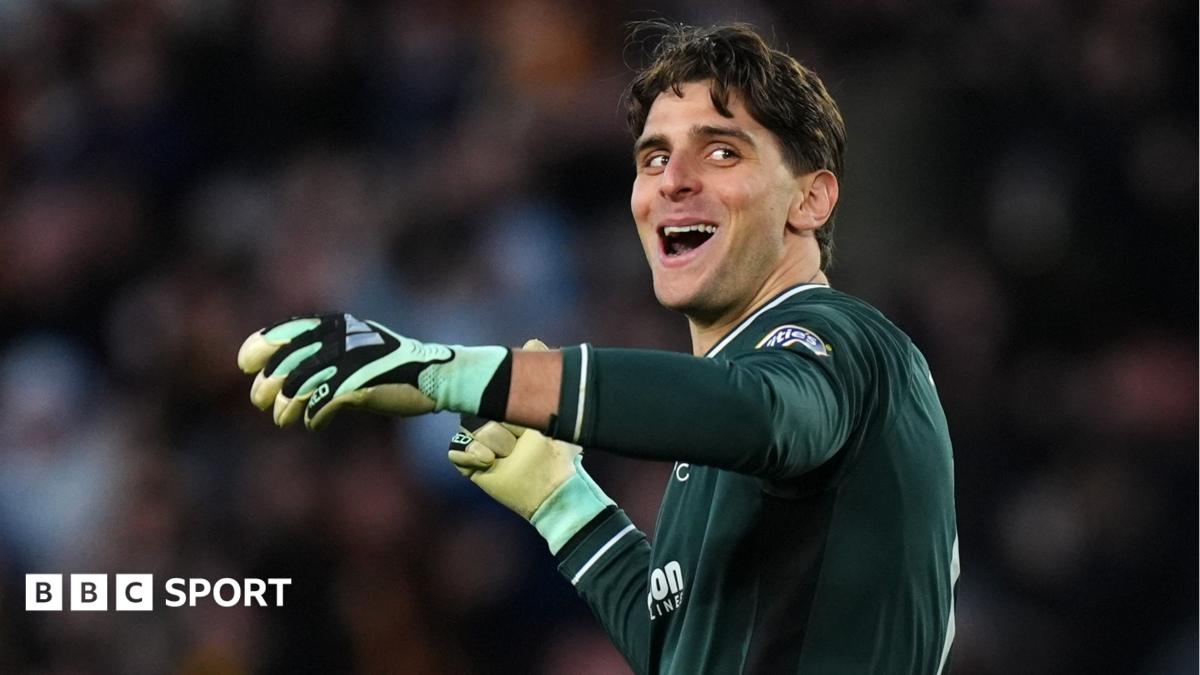
Hull goalkeeper Konstantinos Tzolakis bounced back from a 7-goal nightmare for Greece to produce a masterclass display against Brighton. What can young players learn from his remarkable redemption arc?
PSG Face a Tactical Test After Désiré Doué’s Injury
Desire Doue's ruptured ACL adds to PSG's growing injury crisis, altering their tactical approach. How will this impact their domestic and European ambitions?